SCIENCE AND SPIRITUALITY
from, Leaping Without Words: Cultivating and Exploring the Sacred through Writing and Reading, pages 39-51.
Science presently occupies the most influential methodology for formulating the modes in which human beings carry out inquiries into the context and nature of our locatedness in the universe. If approaches to inquiry being suggested by the new understanding of spirituality are to have any staying power, they somehow have to find a basis on which to contend with and speak to scientifically accepted norms and conventions, or alternatively, indicate some basis on which those conventions need to be modified or laid aside.
There is an ongoing questioning of conventional science by spirituality and a recognition that if there is going to be a wider evolution of human consciousness, both science and spirituality need to create a new mode of human inquiry and understanding. What is ironic is that, in many ways, the questioning of science through spirituality is something that arises from scientific discovery more than it does from the discovery of something new emanating from the study and practice of spirituality. Science, after coming face to face with its own shadow, is discovering that this shadow is a territory that has already been occupied by Homo religiosus.
i. The Quantum Question
What happened in science was the expansion of scientific discovery arising from the shift in scientific thinking, from Newtonian physics to Einsteinian physics. Albert Einstein’s theories of relativity (special and general) had the profound effect of shattering Isaac Newton’s mechanistic, static clockwork view of the universe, thereby distilling its attendant sense of absolute time. With the advent of Einstein’s relativity theories, space and time were now seen as conjoined dynamic concepts formulating the functioning of the universe. This was the retrospective impact. The prospective impact, perhaps more profound, were the resulting advances in quantum theory. Quantum physics is very central to what is in view here, so an overview of its development deserves attention.
Conventional wisdom at the turn of the nineteenth century maintained that light and energy existed and traveled in wave form. However, discoveries in radiation science showed that the wave theory of light did not account for all the properties of radioactive emission, mainly because observation did not fully support the wave theory of light which, as understood then, essentially suggested infinite levels of radiation at high wave frequencies. Actual observation showed that the energy emitted from radiation at different frequencies was finite, and took roughly the shape of a bell distribution curve. The person who provided the basis for solving this quandary was Max Planck.
In 1900, Planck theorized, by way of calculation, that the graph that can be supported by actual observations of radiation experiments can only be accurate if radiation energy is emitted in discrete quantities he called quanta, quantum for singular. In effect, Planck posited that radioactive emissions are non-randomly quantitized, that is, they are composed of distinct and discrete units whose energy component was in direct proportion to the frequency of the wave, multiplied by a constant (Planck’s constant). The higher the frequency, the higher the radioactive energy emitted up to a maximum point when it would begin to require more energy than is emitted to generate that frequency. With this view, theory and observation were made compatible.
No one fully appreciated the import of Planck’s theory until Albert Einstein demonstrated, in 1905, that Planck’s hypothesis accounted quite precisely for the widely demonstrated photoelectric effect — the effect of the emission of electrons from certain metallic surfaces when light was shone on them at various frequencies. Einstein suggested that this could only be accounted for if light is composed of and travels in distinct energy units (photons) in much the same way as Planck had theorized. The significance of this is it now seemed that light should be regarded as having both the already demonstrated quality of waves (interference) and the quality of particles (photoelectricity), and so indicating a dual wave/particle nature. What was not clear was how these contradictory qualities were related and how they interacted.
Concomitant developments in the early 1900s, mainly through the work of Ernest Rutherford (1910–1913) and Niels Bohr (in 1913), had shown that matter was made of atoms, and that these atoms were composed of particles, namely electrons and protons. It was only a matter of time therefore, before someone extended the interpretation of the wave/particle duality of light to sub-atomic particles and this is precisely what Louis Victor de Broglie argued in 1924.
As usually happens in scientific discovery, Broglie’s theory was physically confirmed in a 1925 laboratory accident (subsequently re-created) which showed that electrons seemed to favor certain trajectories of movement while completely avoiding others. The effect of this demonstrable tendency seemed to confirm a wave quality to the behavior of electron particles.
By 1927, Erwin Schrödinger and Werner Heisenberg had separately worked out the mathematical representations of the wave/particle aspects of sub-atomic particles. In Heisenberg’s case, it precipitated his famous 1927 ‘uncertainty principle’ which states that the precise position and momentum of a subatomic particle cannot be simultaneously determined. That is, the increasingly precise determination of one measurement leads to the increasing attendant imprecision of the other.
With these demonstrations, quantum theory was well on the way. The final and demonstrable effect of the coming together of these quantum theories is quite unnerving, although it has been demonstrated over and over in experiments matching the basic format described below.
Imagine electrons traveling in a container from an electron source to an electron detector, with detector and source separated by a wall with only two openings. Electrons are then made to travel, one at a time, so only one electron is in the whole apparatus at any moment. With only one door open, the distribution of where the electrons are detected confirms that electrons behave like particles, since they congregate in the center area of the detection region and fan out from there. However, with two doors open, again with only one electron traveling from source to detector at any one time and with only that particular electron in the apparatus, the distribution pattern of where the electrons are detected shows an image that indicates that the electrons were interfering with each other. But how could the electrons be interfering with each other, a wave characteristic, when they are not traveling, or being detected, or occupying the apparatus simultaneously? That, is the quantum question.
ii. Implications of the Quantum Question
The implications of the quantum nature of electrons (sub-atomic matter) are enormous. First, it suggests spatial non-locality in that the electrons are somehow able to occupy a space that they are not physically present in, thus interfering with the physically present electron, what some physicists have called, ‘spooky action at a distance.’ Second, it distorts our conception of time as having a past, present, or future. As far as quantum physics demonstrates, time seems to be a singular simultaneity that does not separate events into past, present, or future. These two deductions seem to verify Einstein’s theory of general relativity in that they postulate a dynamic space–time continuum, but one that seems to transcend both of those categories. As can be imagined from these implications, the demonstrable quantum nature of reality was going to cause an endless sequence of head-scratching among physicists and lay people alike.
Two basic interpretations of quantum physics have surfaced, one represented by the Copenhagen school of interpretation as argued by Niels Bohr, Werner Heisenberg, and others. The other, considered maverick, is represented by the theories put forward by David Bohm and should be seen as a continuation of Einstein’s guarded stand against the Copenhagen group of interpreters.
In brief, the Copenhagen interpreters argue that quantum reality is a direct result of the observation process. In other words, we cannot postulate that this is the way things are, only that this is the way things are as we observe them. Reality, from this sense, and all that can be understood, is what exists in the presence of observation.
Einstein’s response to this was a guarded no. According to Einstein, the inherent uncertainty and probability effects demanded by quantum theory and physics should not be seen as precluding an underlying, though as yet unverifiable, objective order. Einstein tried valiantly, in the last thirty years of his life, to formulate such an objective unifying order but ultimately confessed failure. However, what he seems to have succeeded in doing was impressing the reasonableness of his idea of an all-inclusive though unobserved underlying reality to David Bohm, a contemporary physicist and colleague of his at Princeton.
Bohm had written a textbook on quantum theory, much after the Copenhagen line of interpretation. In subsequent discussions about the book with Einstein, Bohm revised his understanding and interpretation of quantum theory. Bohm’s revised argument basically postulates that the only way to satisfactorily account for the quantum nature of reality is through the recognition of an implicate order that is parallel to our own explicate physical reality. Bohm viewed this implicate reality in much the same way we think of a hologram.
Bohm’s ideas go much much further than this so most physicists simply dismissed or discounted him. In most quantum texts propounding the Copenhagen line of thinking he does not even get a mention, and yet his ideas are the ones that have faced up most openly to what the quantum nature of reality seems to suggest, essentially that, as suggested by Einstein, a bottom aspect to reality does exist. The quirky nature of sub-atomic particles is a representation of their participation and interconnectedness to this bottom aspect of reality. The only problem is that it is something that can only be accounted for by being posited in a ‘beyond space–time’ category, which essentially means a unifying theorem cannot be constructed merely from objective observation and deduction, but rather through another category of thought that supersedes the observational and the objective.
What we can objectively say, although most scientists do not, is that quantum particle behavior suggests the presence of a wavelike reality that is spread out through space–time. At the very least, this basic scenario has to be consented to. From this reflection, the only way in which quantum particle behavior can then be accounted for would be to remove the speed of light limitation posited by general relativity. On the other hand, since this sub-quantum wave reality would be in a ‘beyond space–time’ category, perhaps one need not think in terms of spatial locations from and to which light would need to travel. With that sense, there would be no need to think of a speed of light limitation because the ‘beyond space–time’ category would have no distance, no here or there, and no now or then.
It is totally mind-boggling of course, and humbling, but this is what our physical reality suggests itself to be grounded in and to be emanating from. The surprising thing is that this logical process of thinking has not at all been the scientific convention. Science, it seems, has opted to not follow its own inherent logic, and has largely refused to take the leap into the non-objective reality that demonstrations in quantum physics seem to demand.1
iii. Art and the Science of Uncertainty
No single text has done as much as Thomas Kuhn’s The Structure of Scientific Revolutions in establishing the fact that scientific discovery and bases for inquiry move by fits and starts, the now clichéd ‘paradigm shift.’ Thus, within the frame of scientific enterprise, the sheer force and impact of a fresh idea can force the shedding of old ideas and the embrace of newer, more accurate representations of reality. So far so good.
When paradigm shifts occur within the context of a largely singular ideological context, the shift from one paradigm to the next comes handily enough. However, when new scientific paradigms involve not just changes of scientific bases but shifts of ideological bases as well, things get more dicey. It cannot be far-fetched to postulate that science has never been faced with as great a potential revolutionizing impact as the one advanced by the changes required by both the ideological and procedural approaches of the new physics of quantum reality. Perhaps only the Copernican and Galilean revolutions are in the same vein.
The key here is that contemporary scientific interpretations emanating from quantum physics constitute a major ideological shift (still in motion), from an objectivist ideology whose last shining brilliance was perhaps produced by Albert Einstein, to the genus of a new scientific frame of mind that requires a wholly different mode of inquiry. It is clearly apparent that objectivist frameworks are simply not adequate to account for the thoroughly involving nature of reality at the subatomic level. The ideal of an objective observer analyzing an uninvolved separate object is, to say the least, completely illusory, simply because there does not seem to be, anywhere, a separate stand-alone aspect to reality. Objective idealism does not exist, only the results of an interconnected and therefore participative mode of knowing.2
The problem however is that this realization requires such a profound change in the ways we think and conduct inquiry, speak and live our lives, it is unlikely that we will ever stop or change until we are obliged to. The changes involved are simply too radical. The irony of this is that by perpetuating (contrary to Kuhn’s model) what now appears to be a false model of reality (conventional objectivism), science has itself become irrational. Even though the alternative modes of discovery and inquiry are still in flux, it is fair to say that many of the changes entailed by the new view of reality have simply been ignored or shelved. The nuances of this kind of dereliction have been clearly expressed by Michael Polanyi. He writes:
“We cannot truly account for our acceptance of such theories without endorsing our acknowledgement of a beauty that exhilarates and a profundity that entrances us. Yet the prevailing conception of science, based on the disjunction of subjectivity and objectivity, seeks — and must seek at all costs — to eliminate from science such passionate, personal, human appraisals of theories, or at least to minimize their function to that of a negligible by-play. For modern man has set up as the ideal of knowledge the conception of natural science as a set of statements which is ‘objective’ in the sense that its substance is entirely determined by observation, even while its presentation may be shaped by convention. This conception, stemming from a craving rooted in the very depths of our culture, would be shattered if the intuition of rationality in nature had to be acknowledged as a justifiable and indeed essential part of scientific theory. That is why scientific theory is represented as a mere economical description of facts; or as embodying a conventional policy for drawing empirical inferences; or as a working hypothesis, suited to man’s practical convenience — interpretations that all deliberately overlook the rational core of science.”3
The ‘rational core of science’ is of course what proceeds precisely on the position that what one can discover is a direct postulate of what one has already discovered. One proceeds on the basis of committing to an already suggestively present vision of reality even though one is not yet able to fully comprehend or explain it. This is the fuel and urging passion of a truly objective scientific inquiry.4
Following from this, the present general scientific scenario is tantamount to a refusal to remain rational and according to Polanyi, therefore constitutes a “pseudo-substitution . . . used to play down man’s real and indispensable intellectual powers for the sake of maintaining an ‘objectivist’ framework which in fact cannot account for them. It works by defining scientific merit in terms of its relatively trivial features, and making these function then in the same way as the true terms they are supposed to replace.”5
What is needed is no less than the acknowledgement and means of embracing and practicalizing the suggestibility of the universe as fundamentally non-predictable and non-determinative, that is, at least not along the usual ways we have sought to construct what we call objective truth. The developments of quantum theory and physics indicate that we cannot proceed from the premise that truth is derived only from exactitude, but rather, from the mutual complementarity of things. Therefore a new, but also old, way of understanding truth is needed, namely that of truth as art. The strange thing is we already know this, and yet somehow, we have fooled ourselves into believing the truth of determinative certitude exists and can be attained. What appears to us to be a precise knowledge is actually founded and grounded upon what Jacob Bronowski, arguing from Heisenberg’s uncertainty principle, calls a region of tolerance:
“We cannot ask the world to be exact. If an object (a familiar face, for example) had to be exactly the same before we recognized it, we would never recognize it from one day to the next. We recognize the object to be the same one day to the next. We recognize the object to be the same because it is much the same; it is never exactly like it was, it is tolerably like. In the act of recognition, a judgement is built in — an area of tolerance of uncertainty.”6
All knowledge, according to Bronowski, is therefore limited. We cannot attain God’s point of view, ours is and always will be, a perspectival view built upon the best of what suggests itself to be true, among, all true, multiple possibilities within the region of tolerance. Intolerance, in all its ill-affected ways, emanates from the insistence that there supposedly is a bull’s eye view to truth. Truth — all truth — is derived from a mutuality of representation; it is artistic. What quantum theory impresses on us is that even when it does not appear to be so, when you dig deep enough, you still will find truth to be artistic. In this sense, Albert Hofstadter’s approach of exploring truth as a continuum that always and must culminate in spiritual truth, is quite insightful:
“Truth about is not the only sense of truth, nor is it the ultimate sense of truth. Truth-about is the first in a sequence of forms of truth on which man must build in order to attain to the truth of his own being. . . . The last stage is . . . truth of spirit. Truth of spirit is no longer a truth that belongs merely to cognition, when cognition is thought of as distinguished from will and from the concrete being of man. It is no longer something only knowable. Truth of spirit is first of all a truth of being, where “of” occurs in the possessive, not the objective, case. It is essentially something livable. . . . Spirit includes cognition, and hence truth in the first sense, as truth-about, is included in truth of spiritual being. But truth of spiritual being goes beyond cognition to the actuality of being itself.”7
The truth of art, of which the writing of spirituality is part, must be based on the mutual affirmation of spirit. That is, it must partake in and be partaken by spirit if at all it is to succeed. As the post-Einsteinian years accumulate, it seems more and more the case that there may be no objective unifying formula to reality. In other words, what is being forced upon us is that we must always live with the terror of the power of being creators and artists, that whatever the unifying aspect of reality is, we are in it and of it. Reality has proved to us that nothing is predictively deterministic, that the universe is a web of interrelated realities. This connectivity, it seems, allows us room to breathe, and to choose, and to create. This may be the only unifying formula we are being offered — to be co-creators. Such power, of course, is tremendous, because it entails the possibility for destructiveness.
As we continue to unravel the mysteries of reality and of our own being, there is a foreboding that we may not be ready to wield such power. Physically, we not only have the power to create things, but it seems now, beings. We are only realizing, perhaps too late, that with every creation, we are implicitly also creating a myriad of other realities. Every creation of something re-creates something else — our lives, the way we live, our environment, our future. Nothing is untouched because everything is conjoined and interrelated. More fundamentally, we cannot predict with absolute certainty how one act of creation will determine the outcome of another measurement of reality. What we have to live with is that there will always be a region of uncertainty and therefore a concomitant need for tolerance to the myriad possibilities of effect built into reality. Objective determinism does not exist. If it really did, life would be a prison, but as it is, life is vulnerable, fragile, exposed, but, also vital, and full of a mysterious depth that hints that anything is possible, that we are co-creators.
There is only one condition — we do not know and cannot know the full extent of what we are creating with absolute certainty. We cannot afford to be co-creators with bullheaded, single-minded determination. We must learn to think in patterns of interconnectedness. This creativity requires humility and humbleness. Buddhists call it karuna, compassion. It is not just a personal determination to be humble, but rather a totally encompassing way of life grounded in the recognition that all reality is a single fabric, that the best and greatest wisdom for life is to do no harm. This also means we cannot live compassionately and then turn around and create something, no matter how valuable in the short term, that in the end does violence to the fabric of reality, because in that same movement, it would involve doing violence to ourselves.
The manner and approach of our creativity must parallel the suggestibility of the nature of reality, which, as we continue to explore, is suggesting that it is something deeply rooted in the principle of the interconnectedness of all things and of the attendant need for tolerance and tentativeness to the way we stake things to be. This is the spirit that the writing of spirituality, along with all artistic creation, must deeply absorb and represent.
References:
1. For detailed analyses of the development of the ideas of quantum theory, see the following:
Fritjof Capra, The Tao of Physics, second ed. (Boulder, Co.: Shambhala, 1983), 52–81,150–160, 208–223,309–321; Stephen Hawking, A Brief History of Time (London: Bantam Books, 1988), 59–76, 171–193; David Lindley, The End of Physics: The Myth of a Unified Theory (New York: Basic Books, 1993), 62–100; Michael Talbot, The Holographic Universe (New York: HarperCollins, 1991), 1–55; Christian von Baeyer, Taming the Atom: The Emergence of the Visible Microworld (New York: Random House, 1992), 20–56, 163–178, 194–211.
2. See, Fritjof Capra, The Tao of Physics, 68-69; 141–142.
3. Michael Polanyi, Personal Knowledge: Toward a Post-Critical Philosophy (Chicago: University of Chicago Press, 1958), 15–16.
4. Ibid., 64.
5. Ibid., 16–17.
6. Jacob Bronowski, The Ascent of Man (London: Futura Publications, 1981 [1973, BBC]), 230–31.
7. Albert Hofstadter, Truth and Art (New York: Columbia University Press, 1965), vii–viii.
Christopher Dube, “Science and Spirituality,” in, Leaping Without Words: Cultivating and Exploring the Sacred through Writing and Reading, pages 39-51.

THE PHILOSOPHY OF THE “TAO TE CHING”
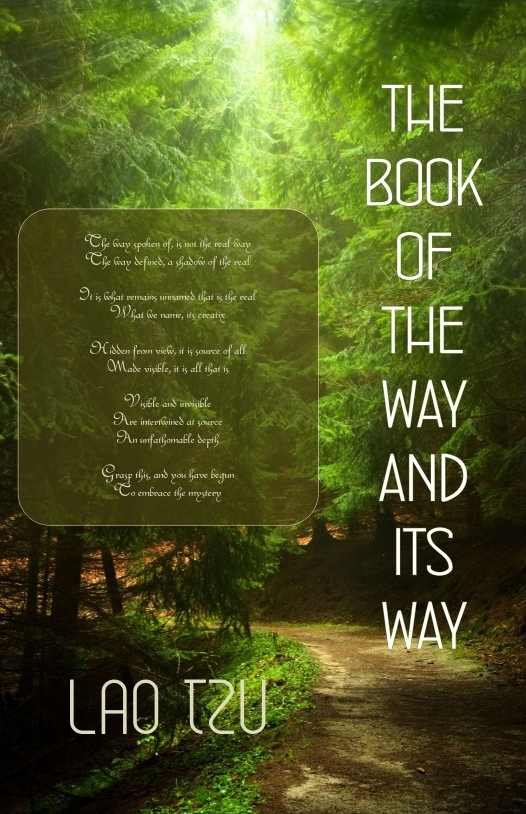
from, The Book of the Way and its Way, pages 11-17, by Jarcq Terra.
One of the most challenging tasks a writer may undertake is to try and describe the ineffable. The ineffable, by its very nature, is difficult to capture and circumscribe in words. It refuses to yield to direct elucidation. Another approach is called for —one that gestures towards the mystery and yet leaves it intact. The language and the words have to partake of the nature of what they are trying to describe. They have to become artifacts of the mystery, effectual vehicles of the presence of the ineffable.
The Tao Te Ching is an examination of the ineffable and of the requisite approach that the ineffable calls for, if it is to be uncovered. It is a masterful textual description of the elusive qualities of the ineffable and a lucid guide on how to approach and mirror those qualities in one’s life and affairs.
Within the Tao Te Ching, the way of approach to the ineffable is ‘the way’; the ineffable is ‘the way’; and the inherent nature and characteristics of the ineffable are ‘the way.’ These three pivots dance around in the text like a precipitous tripod and yet remain perfectly balanced. They become the means through which the writer gestures at ‘the way’ without revealing its final locale, for there is none: “The way is everywhere and in everything” (Thirty-Four. See also, Forty-One).
The place to begin searching for the way is within the present moment and context (Fourteen). In order to get on the trail of the way, one has to begin mirroring the nature of the way within one’s immediate character and person. According to the philosophy of the way, the way is uncovered and discovered by those who live it (Thirty-Two). This circuitous logic is not the only one presented within the text. One could argue that the whole approach of the text is to examine the multiple paradoxes that ensue from considering the nature of the way and how to mirror it in one’s life. In this sense, the philosophy of the Tao Te Ching could be viewed as paradoxic, that is, as derived from seeing the world, and reality in general, from a ‘down side up’ perspective. From the writer’s vantage, the true way of seeing comes out of a perspective that considers lowliness a greater state than elevation. True greatness is lowliness according to the writer (Sixty-One). The focus of the writer is on restoring this truer perspective to things, which, in view of the text’s undergirding philosophy, is inherently demanded by the nature of the way (Thirty-Four; Sixty-Six). That is, the emphasis of the writer is not on turning things ‘up side down,’ but rather on revealing what is weak, yielded, humble, lowly, as precisely what best mirrors the nature of the way.
A vivid example of this approach may be seen in the writer’s use of the imagery of water (Eight; Seventy-Eight). Water is soft, gentle, pliable, and limpid, the very qualities that are inherent to the way. Similarly, those who embrace and reflect the qualities of water within their character begin to partake of the nature of the way. One aspect reflects the other; the qualities that reflect the way are similarly the qualities that endure in the pursuit of the way, namely, gentleness, compassion, lowliness, and yielding. The writer seems to have been painfully aware that this perspective was not the general world view of his or her contemporaries, and so repeated several times throughout the text, is the need to recognize the gentle, pliable, soft, and yielding, as far outlasting the hard, strong, and unyielding (Thirty-Six; Forty-Three; Seventy-Two; Seventy-Eight). This contrast is not merely a reflection of strategic advantage, of the proficiency of one approach over the other, but rather a recognition of mutual participation in the nature of what grounds reality, namely, the way and the real.
According to the Tao Te Ching, the source of all things is the way. The way, in turn, is the inseparable companion of ‘the real’—the unspeakable beyond, the emptiness, the nothing (One; Twenty-One; Twenty-Five; Seventy-Three). The real is the source of the paradoxical nature of the way. It is the still, unmoving centre that does not act, request, speak, or contend, and yet accomplishes, receives, answers, and overcomes (Seventy-Three. See also, Sixteen). The real is the basis for the nonacting action which those in pursuit of the way cultivate and come to embody. A way of doing this (or rather, not doing), is to metaphorically place one’s finger on the heartbeat of the way, which simultaneously, turns out to be the heartbeat of the world. Once the rhythm of the way has been attained, seekers of the way begin to live according to its flow, doing through non-doing and acting through non-action (Forty-Three; Forty-Seven; Sixty-Three. See also, Twenty-Six). That is, they only do what is needed and therefore accomplish everything (Thirty-Eight).
It is important to note that the seeker’s stance of inactive action is not passive. This is because the seeker is consciously engaged with the world without seeking escape from it. The conscious aspect involves the syncing up of the heart of the seeker with the heart of the world, and therefore with the heart and flow of the way, emanating from the fathomless centre of the real. Perceptivity, sensitivity, and nuance, become the indispensable qualities of the seeker of the way. They act like an internal barometer that indicates the emphasis and non-emphasis with which things should be entered into.
Outwardly, the seeker of the way may appear to be what is classically known as ‘the fool.’ This view seems to have been the perceived self-portrait of the writer, at least according to poem Twenty. Such an outward description is misleading though, since it only serves to mask the fierce grasp that the seeker has on the rhythm of the way, which once uncovered, is never again relinquished. The seeker begins to navigate the myriad contexts of life using this rhythmic flow, perceiving within it, the elusive presence of the way, leading him or her to seek harmony, simplicity, humility, naturalness, and yieldedness (Multiple references: see, for example, Five; Ten; Sixteen; Twenty-Two; Twenty-Three; Fifty-Five; Sixty-Four). Seekers who uncover the way therefore acquire an inner awareness that clues them to what the way of the way is and how to yield to it. They begin to tread lightly upon the world, for within it, they now discern the true nature of the real, lurking behind the apparent reality. To the outside observer, the seeker of the way appears tentative, gingerly, humble, limpid, lowly, natural (Fifteen).
What the Tao Te Ching achieves, quite phenomenally, as displayed in the preceding philosophical sketch, is present these ideas through an economy of words that is astounding. Not only does the text manage to address the needs of the individual, its reach extends to the social and the political. Leaders, rulers, teachers, and guides, are re-measured and re-examined using the yardstick of the way and the primary quality of humility that those who serve should, according to the writer, embody (Sixty Six; Sixty-Eight; Seventy-Eight. See also, Thirty-Nine).
The Tao Te Ching also hints at and points to the themes of awakening and enlightenment. Although these themes are not centrally dealt with, the writer makes it quite clear that there is a parallel relationship between the pursuit of the way and the realization of awakening and enlightenment. That is, there are certain attitudes within the pursuit of the way that are a synthesis of the attitudes that are essential for the attainment of enlightenment and awakening. One of these attitudes relates to the awareness of the unitive nature of reality: “The truest enlightenment is one which does not separate,” (Twenty-Eight); (See also, Sixteen; Twenty-Seven; Thirty-Three; Fifty-Two; Fifty -Five; Seventy-One). Another attitude relates to the uncovering of the nature of the real, which at the same time, turns out to be the discovery of one’s true nature, and simultaneously, the uncovering of the nature of the way (Sixteen).
The Tao Te Ching is a very far-ranging and far-reaching text, especially given its brevity. It does two things that its title portends very well—it furnishes a lucid description of the inherent nature of the way, and paints a clear picture of the attitudes and characteristics that must be embraced on an individual, social, and political scale, if the nature of the way is to be mirrored in reality. This, according to the writer, is not merely one suggestion among many other ways of living, but rather, a way of living that mirrors the nature of the source from which reality emanates (Twenty-One). Peace, rest, and true contentment, are discovered only from within the locus and echo of ‘the real.’
Although the Tao Te Ching clearly has thematic focus, it is very likely the work of more than one author, or the work of one author with several secondary contributors. The traditional ascription of authorship is to Lao Tzu, supposedly, an older contemporary of Confucius (551–479 BCE). Very little is known about the historical figure of Lao Tzu, and much of this is clearly based on legend, for example, the story that Lao Tzu composed the text at the behest of a crossing guard. The allusion of this story may have been in reference to the brevity of the text coupled with the sharpness of its vision.
What this version of the Tao Te Ching does is present a hermeneutical extraction of the central philosophical themes of the text, rendering them into clear, lucid statements. The whole text now reads resonantly, and presents itself as the work of one voice, issuing from a singular vision. The title that this version bears is a reflection of this refocusing. The rendering of the text is the result of cross-lateral work straddling several versions and the redaction of the thematic focus of each individual poem. The primary process of focus was to ask, what in essence, was being communicated within the poem, or within the several poems in each numbered strata. The result of this hermeneutical redaction is a clearer text, easily accessible to first readers.
My hope is that this version will make the ancient text of the Tao Te Ching understandable to a wider audience. There is something beautiful, wonderful, and sacred, that is achieved through this visionary work by Lao Tzu. To read these poems is to witness the luminous beauty of the spirit of humanity.
Jarcq Terra, “The Philosophy of the Tao Te Ching,” in, The Book of the Way and its Way, pages 11-17.
